|
Effective Properties
|   |
|
Effective Properties
| |
Bispec computes a number of "effective" properties for nonlinear systems. These properties include effective stiffness, period, frequency, and multiple measures of effective damping.
The effective period and damping are generally considered to represent an equivalent "linear" system with displacement response and energy dissipation characteristics similar to those of the nonlinear system.
The use of effective period and damping is particularly useful when analyzing the response of base-isolated structures and structures with supplemental linear or nonlinear damping.
The following describe how each effective properties is computed.
Effective Stiffness
The effective stiffness Keff is computed as Keff= Fs/Sd
Fs is the corresponding hysteretic force at displacement Sd as defined by the backbone curve. In case the hysteretic curve has different properties in the positive and negative directions, the average of the positive and negative values is used.
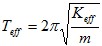
Effective Period and Frequency
The effective period and frequency are computed from Keff as

Effective Inherent (Linear) Viscous Damping (LVD) βIeff (%)
This is the effective damping ratio representing inherent linear viscous damping

where K is the initial stiffness, and βI is the inherent linear visoucous damping.
Effective Supplemental (Nonlinear) Viscous Damping (NLVD) βVeff (%)
This is the effective damping ratio representing supplemental nonlinear viscous damping
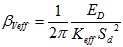
where:
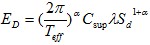
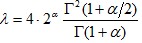
In the above, Csup and α are the nonlinear damping coefficient and exponent, respectively, and Γ is the gamma function.
Effective Hysteretic Damping βHeff (%)
This is the effective viscous damping for an equivalent lienar system with period Teff that represents the effects of energy dissipation due to nonlinear hysteresis.
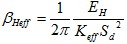
Where:
 , for elastic-perfectly plastic systems, and
 , for bilinear hysteretic systems
Total Effective Damping βTot_eff (%)
The total effective damping is the sum of all effective damping ratios:

References: