|
Damping
|   |
|
Damping
| |
Two types of damping can be defined and used:

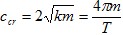


Where Csup is the supplemental damping coefficient and α is the velocity exponent.
Both linear and nonlinear damping can be used in the same analysis simultaneously. This is convenient in cases when there is a need to model both the inherent and supplemental damping. When combined with nonlinear hysteresis, this allows the analysis to account for energy dissipation due to linear viscous damping, nonlinear viscous damping, and hysteretic behavior.
Linear damping is defined as a percentage of critical damping βI. Nonlinear damping is defined by specifying Csup and α. In spectral analysis, it is possible to define a range of damping values. For example, the linear damping percentage can be defined as a single value (e.g. “5”), or as multiple values (e.g. “0,5,10,15,20,30,50,75,100”).
The same can be done for Csup and α. A different number of values can be defined for each of the three parameters. When the values are not the same, Bispec will cycle through the values repeatedly. See below for examples.
Example 1: Equal number of variables
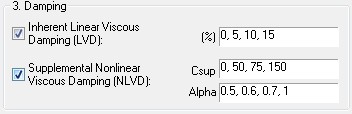
βI = 0,5,10,15
Csup = 0,50,75,150
α = 0.5,0.6,0.7,1.0
Under the above example, four analyses with different damping values will be performed at each period. These correspond to four (βI , Csup , α) triplets of (0,0,0.5), (5,50,0.6), (10,75,0.7) and (15,150,1.0).
Example 2: Equal number of variables for βI and Csup and a single α value
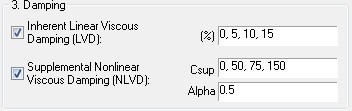
βI = 0,5,10,15
Csup = 0,50,75,150
α = 0.5
Under the above example, four analyses with different damping values will be performed at each period. These correspond to four (βI , Csup , α) triplets of (0,0,0.5), (5,50,0.5), (10,75,0.5) and (15,150,0.5).
Example 3: Different number of variables for βI, Csup and α
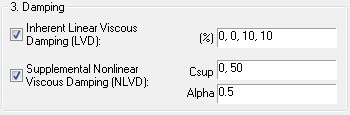
βI = 0,0,10,10
Csup = 0,50
α = 0.5
Under the above example, four analyses with different damping values will be performed at each period. These correspond to four (βI , Csup , α) triplets of (0,0,0.5), (0,50,0.5), (10,0,0.5) and (10,50,0.5).