|
Bidirectional Spectra
|   |
|
Bidirectional Spectra
| |
The earthquake response spectrum can be extended to the bidirectional response of systems responding in two directions simultaneously. The bidirectional spectrum would then represent the biaxial resultant response of systems with various periods. The bidirectional spectrum can generally be extended, with care, to different types of nonlinear spectra. While biaxial peaks can be easily computed for some quantities such as displacements, accelerations and forces - by taking the maximum value of the SRSS of the two directions over the duration of the record - other quantities are more difficult to represent as a bidirectional response. Examples include response quantities such as ductility, especially for systems with different strengths in the two orthogonal directions, and quantities such as measures of energy and damage. Nonetheless, bidirectional spectra can provide a more realistic view of earthquake demand on structures. Depending on the type of structure modeled, both uncoupled and coupled models may be used to model bidirectional capacity interaction. Figure 1 shows a comparison of bidirectional and unidirectional spectra computed using Bispec. The bidirectional displacements are always larger than the displacement in either of the two principal directions.
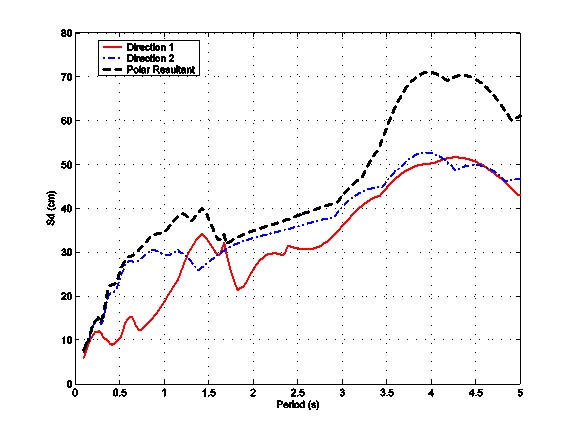
Figure 21: Unidirectional vs. bidirectional constant strength spectra for the Northridge Newhall record.