|
Damage Index
|   |
|
Damage Index
| |
Damage indices are mathematical expressions that are used to predict the failure of a structure or structural member under a given loading history. Working with damage indices presents some difficulties such as determining calibration constants for a particular member, and the computational complexity of some indices. Nonetheless, they are perfectly suited for performance evaluation and constitute a tremendous aid in retrofit decisions and in performance based design. A large number of damage indices have been proposed in the litterature. Those indices are classified into cumulative and non-cumulative. Non-cumulative indices relate the state of damage to instantaneous and peak response quantities such as displacement, ductility, rotation, drift or other physical quantity like stiffness, and do not account for cyclic loading effects. Cumulative indices include part or all of the loading history to predict the capacity reduction due to cyclic repetitive loading. Such indices are computed cumulatively using various measures such as energy, total or plastic deformation, or a combination of these and others. Some other models attempt to predict low-cycle fatigue by applying life and cycle counting rules such as Coffin-Manson, Miner, and other rules. Damage indices are usually normalized such that a value of zero indicates an undamaged state while a value of one indicates failure.
A Example of non-cumulative damage indices is the ductility index. Examples of cumulative damage indices include the Energy index, the Park and Ang damage index (1985), cumulative ductility (Mahin and Lin 1983), and the Bozorgnia and Bertero damage index (2003).
Bispec provides the option of computing the Bozorgnia and Bertero damage index for each sdof system. The spectral quantity can be plotted in the Spectral Analysis Results Dialog, and can be exported for further examination. The index is defined by:
|
|
(Equation-10) |
|
where
|
|
|
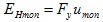
where umon is the ultimate monotonic displacement capacity |
|
|
dissipated hysteretic energy |
|
|
, for inelastic response, and |
|
|
, otherwise |
|
|
monotonic displacement ductility capacity (can be specified in the Analysis Options Dialog) |
|
|
constant (can be specified in the Analysis Options Dialog) |
References: