|
Power & Energy
|   |
|
Power & Energy
| |
A number of energy and power spectral values are computed by Bispec. Generally, each energy term has a corresponding power term as the energy terms can be obtained by integrating the power histories over time, or alternatively, it is possible to obtain the energy terms by integrating power over time.
Starting from the dynamic equilibrium equation (Equation-1), and multiplying by  , the relative velocity of the system, and integrating over the length of response (te), we obtain:
|
|
(Equation-7) |
Defining the following power terms:
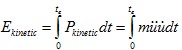
Kinetic Power: 
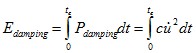
Damping Power:  , but for viscous damping:
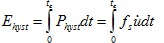
Hysteretic Power:
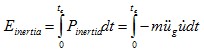
Inertia (Input) Power: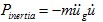
The equation becomes:
|
|
(Equation-8) |
Or,
|
|
(Equation-9) |
Hence,
|
Kinetic Energy: |
|
|
Damping Energy: |
|
|
Hysteretic Energy: |
|
|
Input Inertia Energy: |
|
The hysteretic energy can be further separated into a recoverable elastic portion and a non-recoverable (dissipated) portion as follows:
 , with EElastic defined as:
 , where fs is the current force and K is the elastic stiffness, and

Eelastic is generally thought of as the fully recoverable elastic energy. While this is generally consistent with the above definition for some models (bilinear model and Clough models), it is not very accurate for the other models. The user needs to be aware of the difference in definition. While this also affect EhystNR, the spectral (peak) value for EhystNR is generally not affected, because Ehyst is generally accurate since it is obtained by integrating fs step by step, and EhystNR peaks at the end of the response history, when EElastic is usually zero. Hence, the peak EhystNR is generally independent of the computation of EElastic, except for some cases, particularly when using self-centering models and models with significant stiffness degradation.
PElastic and PhystNR, the elastic and non-recoverable hysteretic powers, are then defined as:
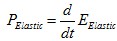 , and
, and
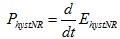
Effect of Nolinear Geometry (PΔ) on Energy and Power Terms
In the above expressions for energy and power, the spring force fs includes the effects of P-Δ, hence the sitffness (K) in the expression for Eelastic is reduced by multiplying by (1-P/KL), and Ehyst is obtained by integration of the area under the global F-u curve including P-Δ effects.